⌕
Cyberdétective® explores the digital trail
Examine publication history, attributable authorship, accessible records and the way a statement is reproduced across websites and social platforms.
Technology background →Nutrition headlines spread quickly. Their supporting evidence does not always follow. Petfood Advisor brings together the digital tracing methods behind Cyberdétective® and the Petfood-Score AI approach to help scrutinise where animal nutrition claims originate and how reliably they are supported.

Large collections of links can create an appearance of authority. A more useful approach asks what each reference actually shows, what has been inferred and what remains to be checked.
Examine publication history, attributable authorship, accessible records and the way a statement is reproduced across websites and social platforms.
Technology background →Organise evidence questions, compare statements across documents and flag contradictions for subsequent human assessment.
See the methodology →Present an understandable explanation of what sources support or fail to support, without prescribing diets for individual animals.
Project background →This is a proposed documentary review framework. It should not be mistaken for an automated certification of scientific validity or a nutritional rating for commercial products.
Research into one species is not automatically transferable to another. A measured result does not necessarily prove a broad health promise. Even authoritative material needs careful interpretation.
Digital research and AI may help locate discrepancies, but they do not replace a scientist’s judgement or veterinary advice.
Review the criteria ↗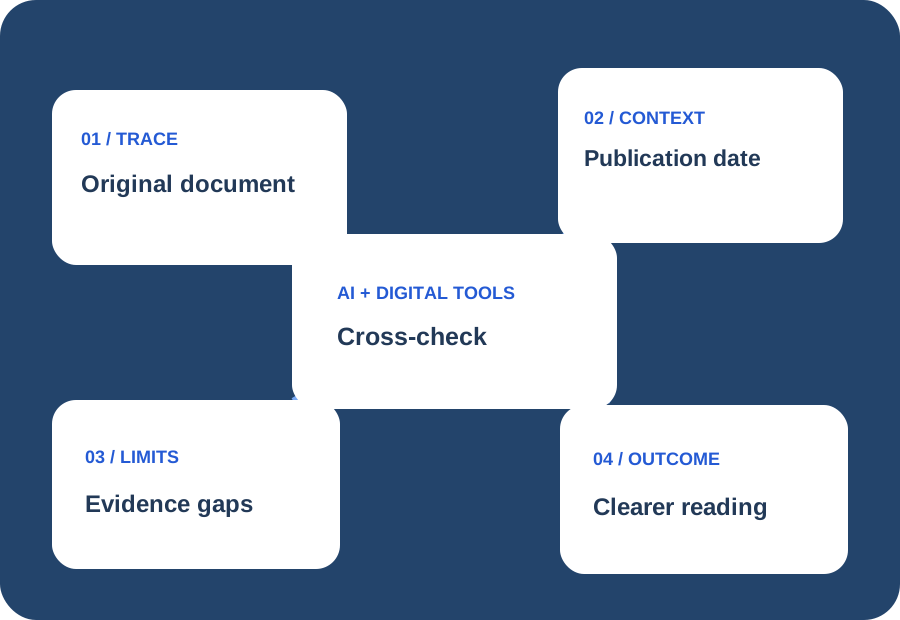
These examples illustrate reasoning methods and do not assess any specific manufacturer or animal food.
| What you may read | What to check | Possible blind spot |
|---|---|---|
| “Backed by clinical science” | The original paper, its design, what it measured and any funding disclosures. | The marketing statement may be broader than the study’s findings. |
| “Natural ingredients guarantee health” | How the claimed benefit is defined and whether outcomes were actually tested. | An appealing label is not the same as demonstrated nutritional suitability. |
| “High protein means high quality” | The reporting basis, moisture content, complete nutrient profile and intended animal. | A single nutrient number lacks the context of an overall diet. |
| “Experts unanimously agree” | Named professional guidance, publication dates and genuine areas of consensus. | Scientific nuance may disappear in a short slogan. |
Mark the checks you have performed when reading an animal nutrition article. This interactive reminder operates within your browser and does not send your answers anywhere.
Five checks to guide research, not a scientific verdict.
No server-side storage of your selections.
This website does not deliver individual nutrition prescriptions. Choosing a diet for a particular animal involves factors such as health status and clinical history, which belong with a qualified veterinary professional.
The approach described here uses lawful, accessible information to review the origins and propagation of published content. Pacta Labs does not perform named-person investigations for third parties.
No. Petfood-Score is presented as an AI and information-review initiative. We do not claim a public certification, official grading scheme or independent scientific approval.
No single paper can resolve all questions. Study design, sample size, reproducibility and relevance to the situation matter; uncertainty sometimes remains despite strong sources.
Discuss the software, workflow, reference material and boundaries of a reliable information-review process.